| Anime: Paprika — Fictional Dream Technology: Dream Sharing |
|---|
3 Synopsis
Suspend your belief in poems, novels, and movies for a moment, however, and imagine that dream sharing is something completely new in the world. How will society react? Will people use the technology to reach a new understanding of themselves, extending the insights of psychoanalysis and philosophy? Such a development would require a great deal of attention to people as individuals. It would probably be easier and more profitable to use the new technology for entertainment. A dream that flatters or pleases dreamers could be mass-distributed. Corporations could hire its distributors to spike it with appetites for products; governments could pay for inducements to passivity or simply for distractions that camouflage what is happening to citizens in the real world. Plato would almost certainly have banned dream sharing from his republic. 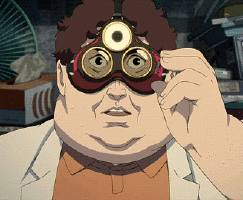 In animated movies, and in live-action movies enhanced by computer graphics, the few constraints that everyday physics once imposed on moviemaking are overcome. The takeover of animation by computers, in the last few decades, may have intensified anxieties. What is the fate of creativity in an electronic age? Will it be the handmaiden of liberation or slavery? Like all great artists, Satoshi Kon, the director of Paprika, seems to have harbored a certain ambivalence about his chosen medium. Though computers have made it possible to automate much animation, Kon liked to draw storyboards for his movies himself, by hand, and in none of his movies did he shrink from challenging the conventions of the genre. Kon seems, in fact, to have seen himself as a little bit at war with the conventions of mass-produced Japanese animation, making them the butt of a joke in the first scene of the first movie he directed. Kon's Perfect Blue, released in 1997, begins with an action sequence by costumed superheroes, set to blaring, triumphant music, but the superheroes are almost immediately revealed to be no more than the mediocre opening act at a rinky-dink outdoor theater. (The joke is reminiscent of the melodramatic action-movie "conclusion" that begins Preston Sturges's Sullivan's Travels.) Perfect Blue is really about the next act at that rinky-dink theater, an all-girl pop group, and in particular, about the identity crisis that the group's lead singer suffers as she transforms herself from an inoffensive teen idol into an actress with roles that are emotionally painful and sexually mature. Kon imagines the young actress being haunted by her pink-tutu-wearing younger self, and it soon becomes difficult for the viewer to distinguish between the actress's real-world agonies and the imaginary ones that she is portraying in her first movie, whose title is, tellingly, "Double Bind." The transitions between reality and fantasy are dizzying. "The real life images and the virtual images come and go quickly," Kon explained in an interview.
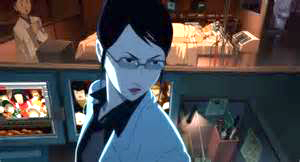
Paprika, released in 2006, reprises these themes: doubles, the misapprehension of the past, the risk of sexuality, the confusion between reality and fantasy. Kon imagines his movie's dream-sharing technology as a small, bent, white wand, shaped like a question mark or a miniature shepherd's crook, with articulated teeth, the size of grains of rice, that glow a soothing robin's egg blue. The DC Mini, as it's called, is cute and menacing at the same time, like the many hand-held devices that one nowadays sees people plugged into on the subway. Its inventor is a childish, absurdly overweight man named Dr. Tokita, whose talent everyone envies. The pioneer in its therapeutic use, however, is a stylish black-haired research psychologist named Dr. Atsuko Chiba, who, since the technology is not yet legal, treats patients only while disguised as red-haired, freckled girl named Paprika. In the movie Inception, which some of you may have seen, there are clear rules about the mechanics of entering dreams. In Paprika, there aren't. There is a mechanism for awakening dreamers, but its function isn't certain. One can never be certain whose dream one is in; in fact, control of a dream may change from moment to moment. The conceit of Inception is that it takes great cunning and much effort to implant an alien idea into someone's mind. In Paprika, such an implantation is distressingly easy. The difficult thing is to learn through dreams how to become oneself.
Kon died of pancreatic cancer in August, 2010 at the age of forty-six. A posthumously posted letter to fans suggested that he had completed storyboards for The Dreaming Machine, a children's movie that may be released later this year. One suspects, though, that Paprika is his masterpiece, and his early death makes more poignant the rich dream at the movie's start, in which one hears the slowing clicks of a movie projector that has come too soon to the end of its reel. How real are dreams? This is the question posed by Satoshi Kon’s animated film Paprika. Paprika explores the relationship between technology and our perceptions of dreams and reality. By exploring the theme of technology in Paprika and other Satoshi Kon films a clear message can be seen. Reality and dreams have similar natures, and our perceptions of them can be changed by technology. Paprika is optimistic about technology, but cautions us to use it responsibly so as not to damage our lives.
The word dream can mean goal or aspiration and this wordplay is exploited by Paprika to help illustrate the message of the film. As dreams begin to merge in the movie, Dr. Tokita speaks of the DC Mini itself being a collective dream because it was the dream of both himself and his assistant and the “entire development team dreamt of its completion.” The conclusion drawn in the movie is that “The crossing of two dreams creates many more dreams.” We find it easy to accept this message because it is couched in terms of experiences that we all have. Few of us would call our dreams false or illusory, but our goals are not physical objects and no one else knows of any of these goals unless we describe a goal to them. This is consistent with nighttime dreams. Paprika also compares the Internet with dreams. Though we usually consider the Internet to be “real” and our dreams to be “illusions,” both are products of our imagination that exist outside of our corporeal selves. When Detective Konakawa, a patient suffering from recurring nightmares, seems surprised to see Paprika in the site radioclub.jp, Paprika asks him “Don’t you think the Internet and dreams are very similar?” Her argument rings true. On the Internet, as in our dreams, we experience anonymity and we have a chance to create our own reality. As in dreams, we have the chance to be free of the restrictions of time, space, and our corporeal selves. To put it as Paprika does, “The Internet and dreams are the means of expressing the inhibitions of mankind.” In the previous two examples it is easy to see the connection between reality, dreams, and the Internet. Both aspirations and the Internet are certainly part of reality; things we experience all the time. Though nighttime dreams do not occur every day, they are still part of reality. Conversely, reality is part of dreams and the Internet. Our goals are based on our real experiences and so is the Internet. Additionally, psychologists have found that nighttime dreams can be a way for our brains to organize and make sense of our recent real-life experiences, further showing the link between reality and dreams. What then, is the difference?
As previously mentioned, Dr. Chiba always treats patients in the character of “Paprika.” This is true up to the point where dreams and reality begin merging, at which point she is seen as herself in dreams. Since our minds create the dreams, the only rational explanation is that she now perceives herself differently in dreams. The solution is simple: Our perceptions are affected by the gaze of others. As we move from dreams to reality we see a continuum of changing gazes. In dreams we own a universe all to ourselves, seen only in our minds’ eye. Aspirations are likewise self-created, but they are liable to be changed by those we share those dreams with. On the Internet, we are still semi-anonymous which one of the reasons why we behave differently there. In real life we can be seen by all those around us. Paprika crosses those boundaries by merging the dreams of everyone. Since all dreams then become public, it is impossible to tell where reality ends and dreams take hold.
Paprika is most obviously a movie about dreams and psychoanalysis, but it is also a movie about movies and about film theory. One of Satoshi Kon and co-writer Seishi Minakami's ingenious adaptive changes when bringing Yasutaka Tsutsui's novel to the screen came in the switch from the originals focus on Jungian psychology to the film's focus on Lacanian psychoanalysis and therefore on Lacanian film theory. From pop culture rock stars like Slavoj Zizek to lesser known scholars like Lee Edelman and Todd McGowan, Lacan has become the basis for much of the development of film theory over the past 40 years, and Paprika explicitly brings a variety of these ideas into the movie theater itself. By combining a psychologist interested in dreams with a detective interested in film, Paprika performs the twin functions of first, creating a parallel between dreams and movies and the way ideas are turned into images and stories, and second, showing how external narratives influence our perceptions of ourselves. When Lacan (and the mystery man in the film) says that "truth has the structure of a fiction" he means just this: our tendency towards narrativization leads us to understand and conceptualize the chaos of our lives in the framework of a traditional narrative, while at the same time unconsciously incorporating narrative elements from external sources ("that's like a line from a mystery novel," "you lived out our movie in real life," etc.). Konakawa's depression and anxiety at the beginning of the film likewise stems from his struggle to narrativize his life. He claims to not like film despite studying it in school and shooting an independent short with his best friend because the homicide case he's working on has reminded him of the traumatic death of this friend, whom he considers as a copy of himself, as "the other me". After confronting this fear, he regains the ability to understand the story of his life, which is why the movie ends on him buying a ticket to the theater.
If this doesn’t sound like your childhood animated flick, it isn’t. But neither is it Ralph Bakshi, the guy who tried to make cartoon movies grow up in the 1970s by way of Fritz the Cat. It’s old news that the great Japanese director Hayao Miyazaki has done his part to steer animation away from Disney-influenced juvenilia, but in the past decade or so, directors like Mamoru Oshii (notably with the virtuosic “Ghost in the Shell: Innocence”) and Mr. Kon have pushed animation film hard into more overtly adult realms. Like the “Ghost in the Shell” animes, “Paprika” explores that intersection between the human and the machine, including the lands of enchantment you can travel to when you plug in, boot up and drop out. Watch the trailer: |
















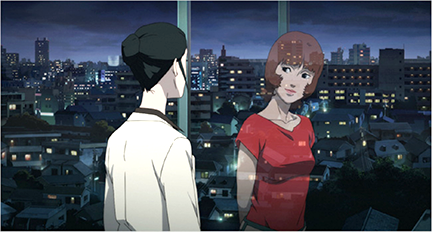 A prototype DC Mini has been stolen, and Paprika is on the case. It’s up to this dream detective to track down and stop the thief through the psychedelic backdrop of people’s dreams. Paprika will need to hurry, before the dream machine does some serious damage.
  When you are watching the film, you sometimes feel like losing yourself, in whichever world you are watching, real or virtual. But after going back and forth between the real world and the virtual world, you eventually find your own identity through your own powers. Nobody can help you do this. You are ultimately the only person who can truly find a place where you know you belong.
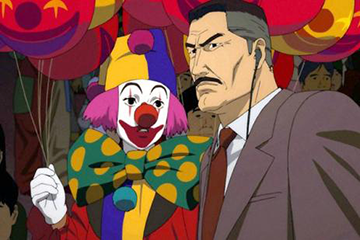
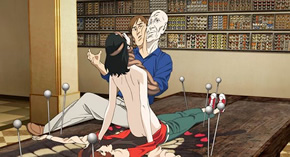 Be patient, Paprika several times advises one of her subjects. Much of the movie is devoted to the interpretation of a single dream, with an attention to detail and a willingness to defer understanding that Freud would not have been ashamed of. But not all the dreams in the movie prove susceptible to analysis. In a particularly dangerous one, we seem to see capitalism run amok—commodities themselves on the march, as if toward an Armageddon or a coronation. The philosopher Martin Buber once warned of "the despotism of the proliferating It under which the I, more and more impotent, is still dreaming that it is in command." Will this someday be humanity's only dream?
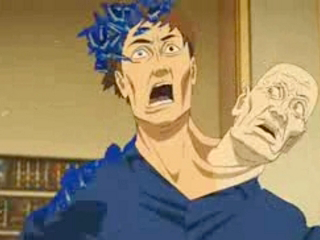 Unfortunately, because of the incompleteness of the device, terrorists steal it and use it to implant malicious dreams into the subconscious of waking people. What we don’t find out until near the end is that the Chairman of the research facility is the terrorist. His motive was to “safeguard the dream world” by sullying the reputation of the DC Mini. Instead of doing so, he is swept up by the power granted by the device and creates a shared dream between all of the movies characters that spills over into real life so that he, who is unable to walk in real life, can be “perfect”. Many people would find it hard to accept that dreams and reality could merge, so Paprika provides some concrete examples.
 To find a satisfactory answer, we need to explore other works by Satoshi Kon and how he uses “the gaze”. According to the theory of “the gaze”, media is generally created with female performances for male audiences who collectively form “the gaze”. Perfect Blue provides an optimal window through which to illustrate gaze theory as used by Satoshi Kon. In this film about a young woman going through a transition from pop singer to actress, “the gaze” is used for exploring character identity. Mima, our main character, is tormented by the negative reaction of her fans and by what appear to be apparitions of her former identity. This persistent, piercing gaze of society combined with the stress of seeing what appears to be an alternate version of herself makes start to lose her sanity. Susan Napier, in her analysis of Perfect Blue, addresses this issue. In a scene from near the beginning of the film the main character is seen staring at her reflection in a train window. According to Napier, this signifies that “even this ‘true’ identity is vulnerable to the gaze of others, including herself.” This fact that we don’t really know our own identity is interesting, and connects well with Paprika.
 Though this explains the merging of dreams in Paprika, it doesn’t fully explore the theme of technology. In both Paprika and Perfect Blue, television plays a role as a perception changing technology. In Perfect Blue the main character is an actress who finds herself confusing her TV personality with her real life. In Paprika, characters literally escape by diving into a TV and out the camera lens. These symbols are complementary. Satoshi Kon, in an interview with The New York Times, was quoted as saying that “In Japan not just children but adults in their 20s and 30s will chose anime and manga as a means of escape from their real lives.” This is symbolized by the escape through the television. Kon then went on to caution against letting our real lives deteriorate as a result of too much technology. The interview was for the release of Paprika, but we see that this message was embedded in both Paprika and Perfect Blue. It isn’t a warning against use, but against misuse. Technology, anime, and manga all have their place in the world, but can create detrimental effects if misused.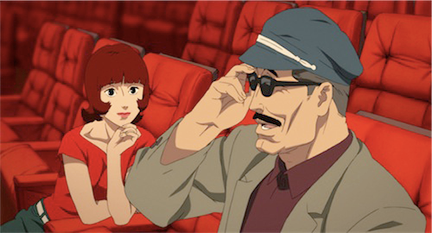
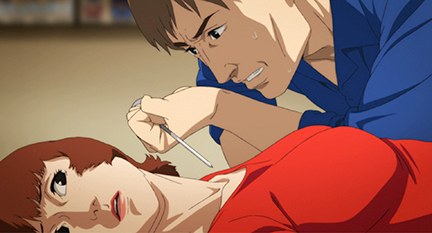
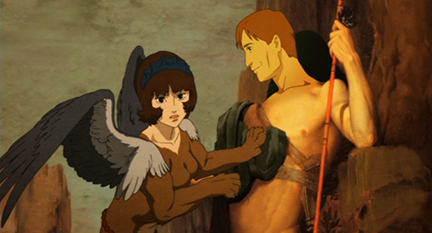
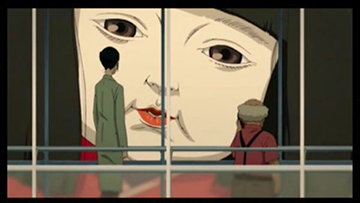 In “Paprika,” a gorgeous riot of future-shock ideas and brightly animated imagery, the doors of perception never close. A mind-twisting, eye-tickling wonder, this anime from the Japanese director Satoshi Kon bears little relation to the greasy, sticky kid stuff that Hollywood churns out, those fatuous fables with wisecracking woodland creatures selling lessons in how to be a good child so you can grow up to be a good citizen. Model behavior isn’t on the menu in “Paprika,” and neither are dinky songs and visuals. Here, when a woman sprouts a pair of wings, she doesn’t only flit about like Tinker Bell; she’s also pinned captive to a table, a man’s hand slithering under her skin.